


ScholarWorks offers long-term storage and public access to the data and datasets produced by labs and researchers at UMass Boston. You can submit your own data to ScholarWorks by clicking the Submit Data link the sidebar on this page.
Please review the Author Submission Policies before submission.
For more information, please visit UMass Boston's Research Data Management Library Guide.
Please email [email protected] if you have any questions or concerns.

-
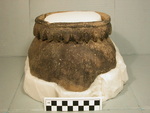
Artifact Catalog from Sylvester Manor UMass Boston Archaeological Work, Shelter Island, NY
Christa M. Beranek, Stephen Mrozowski, David B. Landon, Nedra Lee, John M. Steinberg, John Schoenfelder, Chiara M. Torrini, and Joseph E. Kinney
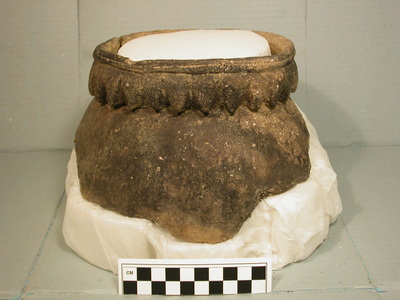
Artifact catalog from Sylvester Manor archaeological work (1998-2025) as of May 2026. The Artifact_List.rtf is a text file listed by unit and context. Artifact_Table.xlsx is the same data, but in tabular form. Unit_Contexts.xlsx is a table listing all the contexts by unit.
Artifact_Table and Artifact_List are very large files.
-

Raw Dataset for 300 University AI Choices
Amanda Potasznik
A log of 300 universities, randomly sampled from IPEDS data, and documentation of their adoption (or not) of Generative AI technology, coded by company.
-
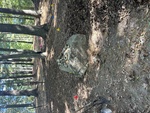
Afro-Indigenous Burial Ground GPR Survey Data from UMass Boston Archaeological Work, Shelter Island, NY
John M. Steinberg, John Schoenfelder, Nedra Lee, Stephen Mrozowski, Chiara M. Torrini, Tess Ostoyich, Claire Ross, Kristen Delatour, and Joseph E. Kinney
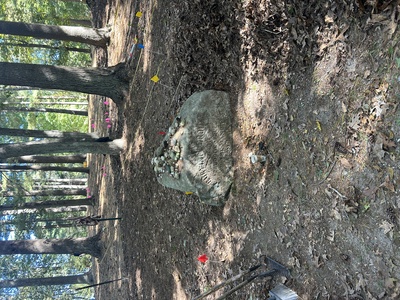
Survey data from the ground penetrating radar (GPR) survey at the Afro-Indigenous Burial Ground (AIBG) at Sylvester Manor, Shelter Island, NY. Zip folder contains raw recorded data (radargrams). Additional files include zipped shapefiles for GPR transects, trees and rocks; and dat file. Fieldstone marker files include zipped folders with an excel sheet listing numbered fieldstone markers, and a sheet listing the photographs of the fieldstone markers. Fieldstone marker number allows tor joining the photographs, and the "rock" shapefile to the list of markers.
The .rd7 files are the type generated by MALA GPR systems to record raw data (they are unprocessed binary data files containing the recorded electrical signals), along with .cor (coordinate data), .mrk (markers on radargrams), .mrkj (modern version of .mrk), and .rad (header file; contains survey parameters, antenna frequency, samples per trace, time window, and velocity) files. These are all needed to work with the raw GPR data.
Each shapefile is comprised of seven different file types: .CPG, .dbf, .prj, .sbn, .shp, .shx, and a .sbx file and all are needed for the shapefiles to function. The .shp files are the main files that store the actual spatial data (points, lines, or polygons). The other files contain character encoding (.CPG), shape attributes (.dbf), projection/coordinate system information (.prj), spatial index information for queries (.sbn, .shx, .sbx).
Description of Marker Database
Markers 1-161 are the original markers mapped in 2021 (Cultural Resource Management Study No. 89). Markers 210 and higher were mapped in 2025, and many are in the surrounding 2025 excavations. The shapefile of the rocks has several maker numbers appended with letters demarking that these rocks have been moved between field seasons. The two Excel tables for markers share common marker numbers for a one-to-many relationship.
-
Family Cemetery GPR Survey Data from Sylvester Manor UMass Boston Archaeological Work, Shelter Island, NY
John M. Steinberg, John Schoenfelder, Stephen Mrozowski, Nedra Lee, Chiara M. Torrini, Tess Ostoyich, Claire Ross, and Joseph E. Kinney
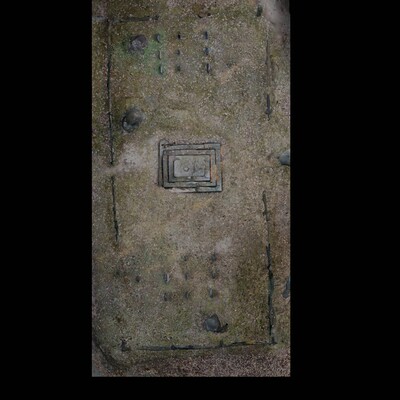
The .rd7 files are the type generated by MALA GPR systems to record raw data (they are unprocessed binary data files containing the recorded electrical signals), along with .cor (coordinate data), .mrk (markers on radargrams), .mrkj (modern version of .mrk), and .rad (header file; contains survey parameters, antenna frequency, samples per trace, time window, and velocity) files. The info.dat file was derived from GPR-Slice. It is a critical ASCII text file that maps the GPR radargram filenames to their specific spatial positions. It defines the survey grid layout, including line lengths, survey direction (X or Y), and profile spacing. These are all needed to work with the raw GPR data.
Each shapefile is comprised of seven different file types: .CPG, .dbf, .prj, .sbn, .shp, .shx, and a .sbx file and all are needed for the shapefiles to function. The .shp files are the main files that store the actual spatial data (points, lines, or polygons). The other files contain character encoding (.CPG), shape attributes (.dbf), projection/coordinate system information (.prj), spatial index information for queries (.sbn, .shx, .sbx).
-
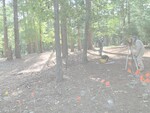
Datums and Benchmarks from Sylvester Manor UMass Boston Archaeological Work, Shelter Island, NY
John M. Steinberg, John Schoenfelder, Chiara M. Torrini, Joseph E. Kinney, Stephen A. Mrozowski, and David B. Landon
Datums from Sylvester Manor Archaeological work (2019-2026). Includes zipped shapefile of points and complementary csv, that includes the site areas for each datum.
-

Datum Reference Photos from Sylvester Manor UMass Boston Archaeological Work, Shelter Island, NY
John M. Steinberg, John Schoenfelder, Chiara M. Torrini, Joseph E. Kinney, Stephen Mrozowski, David B. Landon, and Nedra Lee
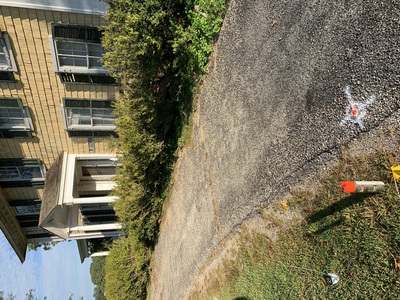
Photographs of site datums used during UMass Boston archaeological work at Sylvester Manor. File names contain the datum name followed by a sequential number. Each datum contains a set of multiple photographs showing its location at a near and far scale, illustrating its exact spot and place in the broader landscape, respectively. Some datums have photographs showing how the survey rod needs to be placed, and some have images that include a pin flag with the datum name written on it. Includes zipped folder.
-
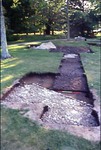
Excavation Units from Sylvester Manor UMass Boston Archaeological Work, Shelter Island, NY
John M. Steinberg, John Schoenfelder, Chiara M. Torrini, Joseph E. Kinney, Stephen Mrozowski, David B. Landon, and Nedra Lee
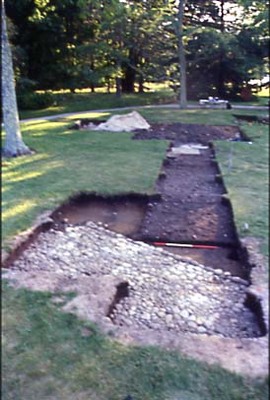
Excavation units from Sylvester Manor archaeological work (1998-2025). Includes zipped polygon shapefile with outlines of excavation units.
-
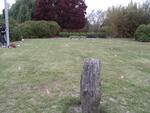
Shovel Test Pits from Sylvester Manor UMass Boston Archaeological Work, Shelter Island, NY
John M. Steinberg, John Schoenfelder, Chiara M. Torrini, Joseph E. Kinney, Stephen Mrozowski, David B. Landon, and Nedra Lee
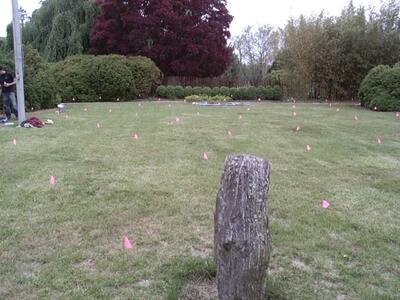
Shovel test pits (STPs) from Sylvester Manor archaeological work (1998-2025). STPs were excavated as 50cm-x-50cm squares and sometimes expanded into larger excavations. These points typically represent the southwest corner of test pits but not always. See shapefile metadata for more information. Includes zipped point shapefile with points each representing one corner of a STP.
-
Dynamics of Thermalization in classical three-dimensional many-body systems: non-Maxwellian distributions and the role of anisotropic trapping
Roberto Onofrio and Bala Sundaram
The physics of interacting baths is of interest in a variety of contexts, ranging from ultracold atoms to ionized gases. While many features can already be captured in a one-dimensional model, others are speci c to the situation of two or three-dimensional systems. In this paper, we focus on three-dimensional features of a model for thermalization between two baths that we have explored in earlier publications. In contrast to the one-dimensional situation we show that, enroute to thermalization, deviations from the Maxwell-Boltzmann energy distributions more akin to -distributions are observed. In three dimensions, these can be seen in changes at the peak of the distribution, which is precluded by the expected monotonic behavior of the energy distributions in one dimension. Furthermore, we consider thermalization for anisotropic trapping and explore its role in the onset of anomalous scaling with respect to the particle number. These results may be pertinent to the understanding of the interplay between turbulent behavior and nonlinearities for a variety of many-body classical systems.
Data is from the figures in this study generated by numerical integration of classical equations of motion using a variable step predictor-corrector method. The single zip file contains data and other zipped data files associated with the figures in the paper.
-
Generation of non-Maxwell-Boltzmann energy distributions during thermalization of interacting baths
Roberto Onofrio and Bala Sundaram
data associated with all the figures in the publication.
-
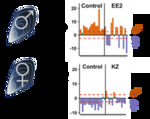
Sex Identification of Mytilus edulis following 26 day treatment to EE2 and KZ
Helen C. Poynton and K. Garrett Evensen
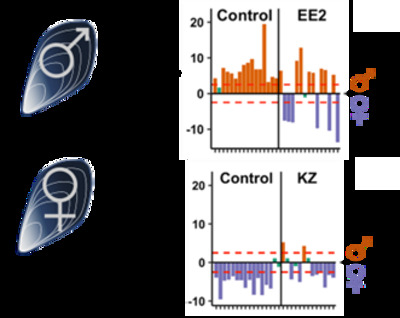
Blue mussel M. edulis were exposed for 26 days to 50 ng/L 17alpha-ethinylestradiol or 30 ug/L ketoconazole for 26 days in four replicate tanks. Prior to exposure, mussel sex was identified using the VERL-VCL RT-qPCR assay on hemolymph collected from each mussel. Following exposure, mantle tissue was collected from each treated mussel and the VERL-VCL RT-qPCR assay was used to identify the sex of the mussels.